Showing posts with label House Rule. Show all posts

Thursday, December 20, 2018

Called Shots


So a way for Boo to go for the eyes is a must but the standard rules are silent. So what to do? In my experience this can quickly get out of control if it is just a simple minus to hit. Every boss being blinded turn one for the rest of the combat by that plus ten to hit multi-attack ranger gets lame really fast. Beyond being on target it should also be a difficult usage of a specific ability to pull off a called shot. So how do we define this in game terms. In lieu of standard attack damage you may declare your intention to achieve an effect. For example, a player may declare they will attack the orc they snuck up behind but want to go for a crack to the back of the head to stun. The DM may either announce a DC and ability check to achieve the effect or declare the condition is not possible. The player will have to make a standard to hit roll and then make the successful ability check to achieve the effect instead of regular damage. If either the to hit roll or the ability check fails, the player has failed and the target suffers no damage or effect. After considering the DC and ability check required the player may choose to instead proceed with a standard attack. Examples of reasonable effects to declare are listed below.

  • Blind with sand in the eyes (dexterity for right timing, lasts until end of the target's next turn)
  • Stun with a head butt (strength to create enough force, lasts until end of the target's next turn)
  • Knock prone with strike to leg (ability based on weapon used, note target will not be able to simply get up on the start of their next turn when done as called shot.)
  • Disarm with strike to the hand (ability based on weapon used, knocking a target’s equipped item a desired distance and direction is reasonable to declare)
  • Critical hit with a parkour leaping attack off wall (acrobatics, see house rule for critical hits)
So it really becomes a straight forward decision by the player to press their luck after being on target for an effect other than just regular abstract damage. 

Monday, December 17, 2018

System Shock

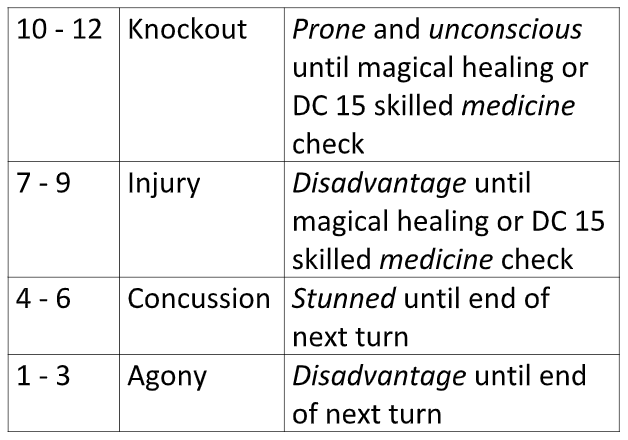
One thing I liked about the old BattleTech table top game was filling in those little circles to account for lasers and missiles blasting away at mech armor until the volleys reached the soft center and started doing lasting damage. Felt dramatic to me. Combine that with in D&D 5e the idea of taking a nasty war hammer blow to the head with no chance of your bell being rung per the standard rules. Doesn't seem right. To model being susceptible to notable and sustained damage I use a house system shock rule. Notably vicious blows should impair the target beyond simple damage because bones break and brains get concussions before the target drops dead. My first thought was that as part of a critical hit you would have a system shock. That thematically felt right but after thinking it through it is flawed. You should not have a level one wizard wielding a dagger run up to adult dragon and in one lucky jab possibly give the dragon a concussion. Too silly. So instead notably vicious is measured by amount of damage from a single blow. A single blow that does more than half of the targets remaining hit points feels like a good amount. Remaining hit points is key here. As any target is beaten down it becomes more and more susceptible to additional injury. Imagine Rocky against Drago in the final rounds with face a swollen mess, barely able to stand, and just one more solid blow could be a knockout. So each time more than half of target's remaining hit points are inflicted by a single blow the attacker rolls 1d12 and consults the table below.


So notice that the medicine check has to be by someone that is proficient in the medicine skill. It doesn't make sense to me that Bob the Ranger who doesn't know a contusion from a concussion can just have a go at a dislocated shoulder and huzzah I happened to roll a seventeen.

Saturday, December 15, 2018

Speed Factor

Why would a player choose to drop their long sword and grab that dagger in their boot? To make a lightning quick finishing stab before the orc can heave it's great ax for another attack. Alas the standard rules for initiative say the only factor to determine combat order is the measure of agility, reflexes, and balance of the player. What? Providing meaningful tactical combat options for a player is engaging. If a player chooses to wear light armor and use a light weapon because she wants to role play a quick ninja stabby type that should be supported. So in game combat she should usually have the jump on an opponent decked out in say plate mail and halberd...because physics. The equipped armor, wielded weapon, and other tasking actions chosen by the player for that round should have a bearing on combat initiative in order to provide engaging tactical options. I do very much also like the idea that casting higher level spells is more tasking. Seems right that you would have to wave those hands harder and recite more complex litanies to launch a fireball over a simple fire bolt. The last thought on tactical flexibility is choosing to just run all out seems like it should give you the edge. To these ends my speed factor house rule is at the start of the round to first require each player to commit to a declared action, not to a specific act though. So what I mean is Bob the Ranger commits to attack this round, he doesn't need to declare that he will attack the orc behind the table with his crossbow. If when the players turn arrives the tactical landscape has changed they may always choose to forgo that action at the last moment. After declaring an action each player rolls initiative as usual but modifies it additionally according to the table below.


Lumbering walking tanks will usually go after quick ninja stabby types now and rightfully so! A player now has a reason to choose to drop that long sword and go for the dagger in the boot.

Friday, December 14, 2018

Critical Hits

As the roll to hit bounces and settles on the table revealing to eager eyes the ever sought after natural twenty the players erupt in a chorus of excitement. Rightfully so, because the player has critically hit some foul evil creature, which certainly must mean they have really brought the wrath of the heroism down, right? With the standard rule you "roll all of the attack's damage dice twice and add them together". Well that sounds good right, it sounds like you are doubling the damage? Not so much. There are very few worse let downs in the game than after rolling the precious critical hit to then roll your d10 damage dice with a result of say two followed by perhaps one. Lame. But beyond just not being a good in game result it extinguishes that moment of joy like a puff of wind on a briefly lit candle. The critical hit should always do more damage than any plain old regular hit, always. To this end my house rule for critical hits is to roll your regular damage dice and then add the max face value of each die to the result. Now we are doing some extra ordinary damage. Huzzah.